New laser system delivers first experiment
New laser system delivers first experiment
Researchers have run the first experiment on a new HiLUX laser system at the Central Laser Facility (CLF) at Harwell Campus, studying the properties of chiral two-dimensional perovskites, materials that have potential uses in secure communications, medical imaging and quantum technology.
Researchers from Queen Mary University of London and the Leibniz Institute for Solid State and Materials Research in Dresden have completed the first experiment using HiLUX, one of several new ultrafast laser systems being installed at CLF
HiLUX is a £17 million transformation of the CLF’s ultrafast laser spectroscopy infrastructure, replacing the facility’s decade-old titanium sapphire ULTRA and Artemis laser systems with a new generation of ytterbium-based lasers.
The upgrade delivers improvements in repetition rate, operational reliability, and data quality, including a near tenfold improvement in signal-to-noise ratio, while also reducing the facility’s electrical power and cooling demands.
HiLUX’s first light was achieved on the ULTRA infrared laser system, with the Artemis extreme-ultraviolet system expected to follow later this year.
Impact for researchers
Dr Nathaniel Gallop, who recently moved from the Leibniz Institute to Queen Mary University, described the impact of the new system:
The experiments have gone fantastically! I’ve worked with these materials for a few years, and they are exceptionally challenging to study. I was initially worried that it would be a battle to measure the things we needed to measure.
However, the new HiLUX laser system has made this process a breeze: measurements that we had initially allocated entire days to take only needed a few hours in the end.
The staff, particularly Ryan and Greg, have been wonderfully supportive and have made the entire experience smoother than I’d have ever hoped!
Impact for CLF staff
For CLF staff, the upgrade has also changed how they are able to support visiting researchers. Dr Phelps said:
In recent years I have become accustomed to daily laser realignments and troubleshooting of system failures, taking me away from the actual cutting-edge science.
This recent upgrade has completely changed where my efforts are placed as a facility scientist; I now have more time to discuss data with users and provide deeper input on experimental design and interpretation.
This shift will allow me to contribute more directly to the scientific output of the facility, rather than focusing primarily on maintaining system operability.
New capabilities
The upgraded infrastructure boosts laser power by 10 to 100 times and opens access to a broad spectrum of secondary light sources, from infrared to extreme ultraviolet.
This enables researchers to study a wider range of physical and chemical processes with greater precision, including the ability to:
- observe both vibrational and electronic properties of molecules over cascades of timescales (femtoseconds to seconds) in a single experiment
- detect previously hidden signals with new levels of signal-to-noise
- support faster, more automated experimentation to enable scientists to try different ideas out on their precious samples, within a single visit
Funding and delivery
The new laser systems were manufactured by Light Conversion and delivered through Photonics Solutions to CLF’s specifications.
Mechanical design support throughout the project was provided by the Projects and Mechanical Engineering group at STFC’s Technology Department.
This investment is supported by UKRI, through the Infrastructure Fund.
Top image:
Credit: STFC Central Laser Facility.
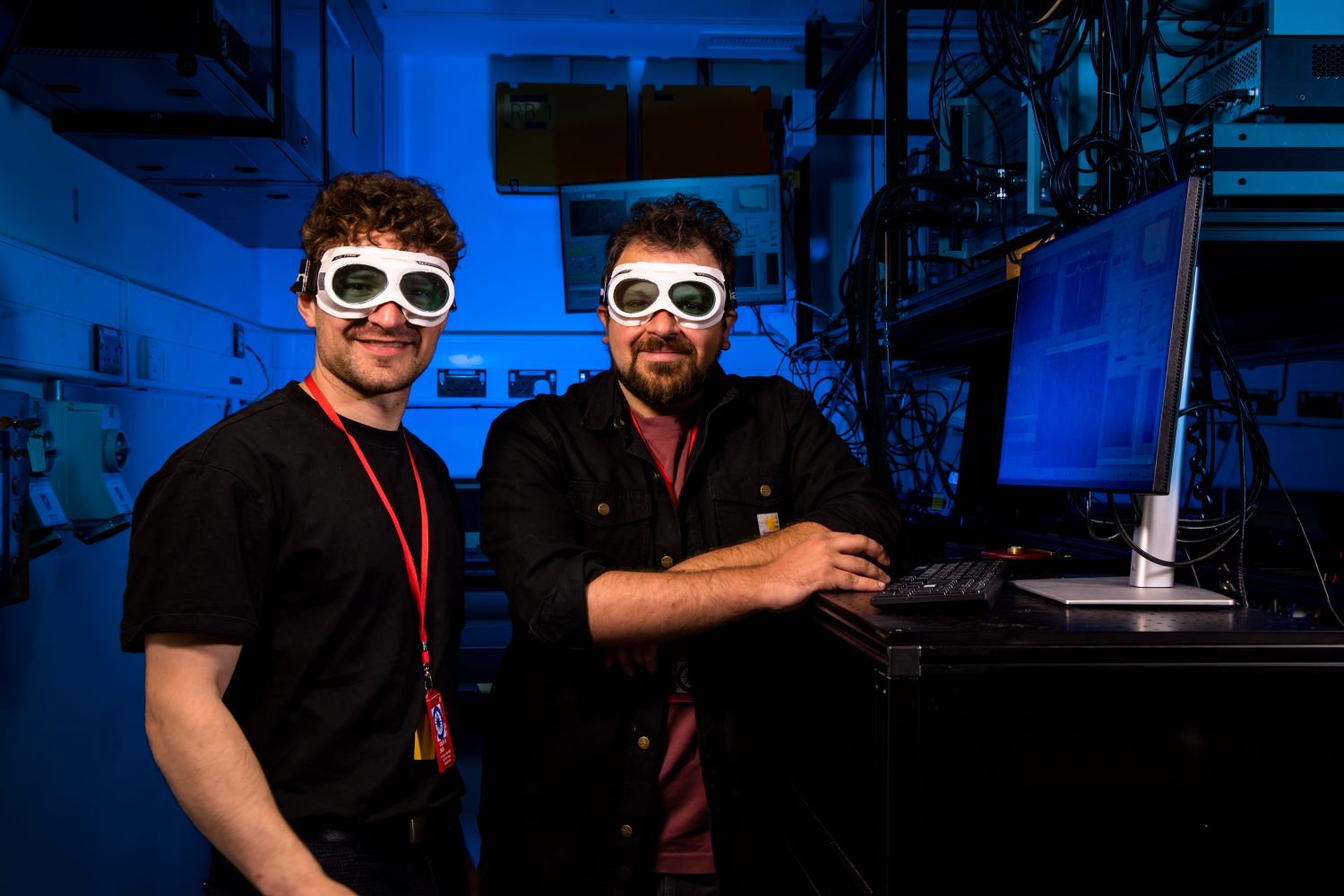
From left to right: Richard Beier and Dr Nathaniel Gallop with the first experiment to run on Artemis at the Central Laser Facility.
Original news article can be found here: https://www.ukri.org/news/new-laser-system-delivers-first-experiment/
Related news
-
New funding to support the next generation of medical and materials breakthroughs
Thousands of patients and innovative businesses are set to receive a boost from over £162 million of funding for trailblazing science announced today (Monday 14 September) for two leading research institutes to create the medical technology and materials of the future. Based at Harwell Campus, The Rosalind Franklin Institute, a research centre dedicated to developing new…
-

UK gov selects Open Cosmos as approved provider for £8bn Sovereign Comms framework
Oxfordshire-based space company, Open Cosmos, has been selected by the British Government Commercial Agency (GCA) as an officially certified and vetted partner to provide satellite connectivity via its low Earth orbit (LEO) constellation, ConnectedCosmos, as the UK seeks to build its own sovereign connectivity architecture. Open Cosmos has been named as a supplier in Lot…
-
Harwell Campus and Diamond Light Source Unveil Supersized Public Artwork Celebrating Scientific Discovery
Harwell Campus and Diamond Light Source, the UK’s national synchrotron, have unveiled ‘Fragments’, a new public interactive artwork inspired by the pioneering scientific discoveries taking place on campus, celebrating innovation while providing an engaging space for campus members, visitors and the local community. Fragments is a series of three striking large-scale sculptures, inspired by protein-ligand…
