New funding to support the next generation of medical and materials breakthroughs
- The Rosalind Franklin Institute and Henry Royce institute are set to receive over £162 million to drive forward vital medical and materials research.
- Package includes funding for one-of-a-kind microscope which will throw new light on conditions like Inflammatory Bowel Disease and Crohn’s Disease
- Funding to strengthen UK’s status as a world leader in life sciences and materials industry by developing game-changing new tech and getting it to market quickly
Thousands of patients and innovative businesses are set to receive a boost from over £162 million of funding for trailblazing science announced today (Monday 14 September) for two leading research institutes to create the medical technology and materials of the future.
Based at Harwell Campus, The Rosalind Franklin Institute, a research centre dedicated to developing new technologies to address health challenges, will receive a £67.7 million investment to build on its pioneering work in next-generation imaging, engineering, biology and diagnostics. This tech will help us address some of the most pressing health challenges facing our society, from Alzheimer’s to bowel disease by helping researchers to understand more about how these illnesses work and how they can be diagnosed and treated.
The Henry Royce Institute will receive £95 million to continue its world-leading work to keep the UK at the forefront of advanced materials research and turn scientific discoveries into commercial products. The Royce’s work helps to create solutions to some of the key issues facing our society, including developing lighter, more efficient battery technology or using AI to design a new alloy that could replace scarce rare-earth materials used in electrical equipment. It works closely with businesses to commercialise new tech quickly and fuel growth in the UK.
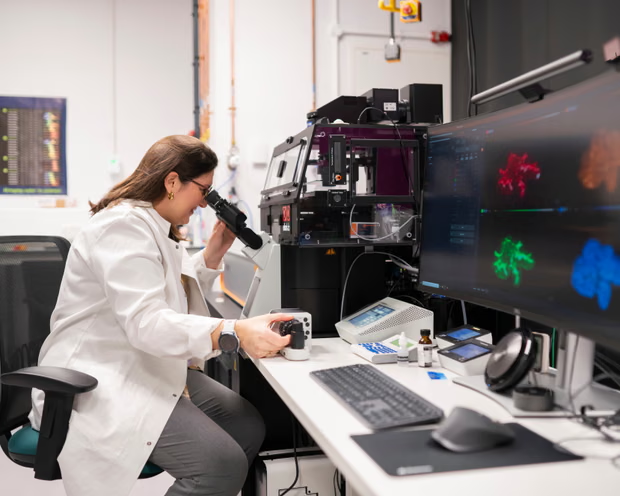
To mark the announcement, Science Minister Chris McDonald unveiled a new one-of-a-kind microscope at the Rosalind Franklin Institute, which will play an important part in the Franklin’s cutting-edge medical research over the coming years.
The Stimulated Emission Depletion (STED) microscope will allow researchers to see inside living gut cells in far greater detail than ever before and in real time, offering new understanding of inflammatory bowel disease. These insights could pave the way for new treatments for the half a million people living with the condition in the UK.
Whereas a normal microscope shows the outer shapes of a cell, the STED microscope lets researchers see the fine structures and layers inside it. The research team will use it to see how cells in the gut and other surfaces in the body behave when healthy versus when affected by illnesses like Crohn’s disease, gastric cancer and IBD.
Science Minister Chris McDonald said:
“We have world leading science research in the UK that pushes the boundaries of knowledge. It is the foundation of our mission to reindustrialise the country, creating good, well paid jobs by developing new technologies and growing British companies.
“The Rosalind Franklin Institute and the Henry Royce Institute are world leading in their fields. Combining biological knowledge, advanced physics and materials development to understand how the cells in our bodies function, and can be repaired and treated with precision medicines.
“The research gives our country a competitive edge, so long as we commercialise it in industry. Developing new medical technologies and treatments and bringing them to market is good for jobs and good for health, making a real impact on people’s lives.”
Executive Director for the Strategy Directorate at the Engineering and Physical Science Research Council (UKRI), Dr Kedar Pandya, said:
“The Rosalind Franklin Institute and Henry Royce Institute have a proven track record of turning public investment into research that advances knowledge, improves lives and drives growth.”
“This continued funding from UKRI builds on that success. It will give researchers the tools and resources to answer some of the biggest questions in the health and advanced materials industries, keeping the UK at the forefront of global science and engineering.”
These two institutes are turning brilliant science into real-world impact, and contributing to the UK’s leadership in two vital sectors – life sciences and the advanced materials industry, both of which are among the eight high growth sectors targeted for support in the government’s Industrial Strategy.
Their world-leading facilities, anchored at Harwell in Didcot for the Franklin and Manchester for the Royce, will provide new equipment and infrastructure for scientists, industry partners and as well as working closely with businesses across the country.
Already, Royce’s battery development facility has supported Molyon, a University of Cambridge spin-out, in creating a new generation of lithium-sulphur batteries that are lighter, more sustainable and can store twice as much energy as current models. The breakthrough has helped Molyon raise $4.6 million in seed funding to bring the technology to market.
This is just one example of how these institutes support connections between cutting edge research and British businesses, helping to make sure that the UK’s scientific excellence translates into jobs, new investment and economic growth in every part of the country, as set out in the government’s 10-year Industrial Strategy. This funding is delivered through UK Research and Innovation, with the intention to deliver the greatest possible impact.
Professor Paul Matthews, Director of the Rosalind Franklin Institute, said:
“We are delighted to have the strong endorsement of the UK government for our future plans.
“The Franklin’s work over the next 5 five years will build a new generation of imaging, chemistry and AI tools that let us see disease processes clearly enough – from single molecules to whole organs – to identify disease earlier and confidently ‘drug the currently undruggable’.”
Professor Paul Monks, Chair, Henry Royce Institute said:
“The achievements of the Henry Royce Institute demonstrate what can be accomplished when the UK brings together outstanding people, facilities and institutions around a shared national purpose, but ultimately the measure of our success is in the outcomes that this enables.
“This renewed investment is both a recognition of what the Royce Partnership has achieved and a huge vote of confidence in its future. Advanced materials underpin almost every technology that will shape a more sustainable and prosperous economy, and our next phase will be increasingly focused on translating our national capability into tangible outcomes for the economy, society and the environment.
“By deepening our national and international impact and forging stronger connections between research and industry, we want to ensure that great materials science leads to real-world innovation, while keeping the UK at the forefront of advanced materials.”
