Ten ways ESA’s UK site boosts Europe’s space ambition
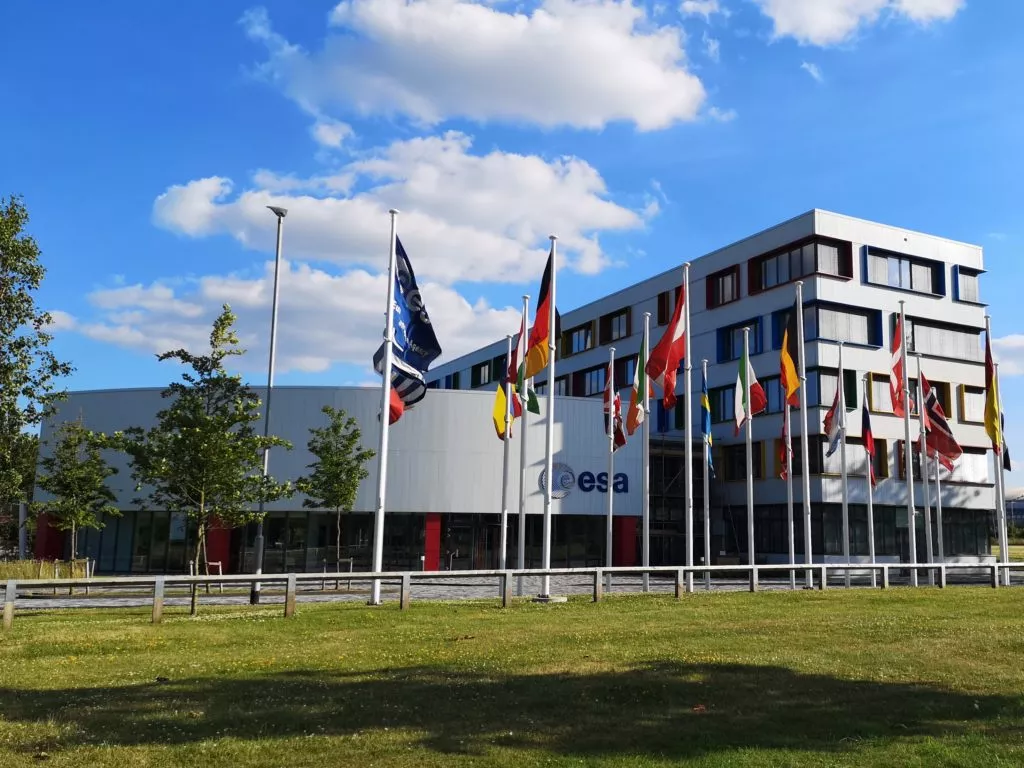
Ten years ago today the flags at the European Centre for Space Applications and Telecommunications (ECSAT) were raised for the first time, marking a milestone moment that rocket-fuelled the European Space Agency’s strong and enduring collaboration with the UK.
ESA’s ECSAT facility is located on the Harwell Campus in Oxfordshire. It was first established in 2009 and its purpose-build office building – named after ESA’s first Director General Roy Gibson – was inaugurated on 9 July 2015. Since then, the establishment has continued to expand and is now home to around 170 people working across multiple ESA directorares.
To celebrate this anniversary, let’s count down 10 key achievements that demonstrate the excellent contributions of ECSAT to European space activities.
1. Facilitating UK space success
ECSAT was established with a vision to reinforce ESA’s strong partnership with the UK, for the benefit of citizens across ESA Member States. It focuses on enabling connectivity and secure communications; beyond this, it supports the development and commercialisation of space-based solutions for Earth, climate change monitoring, human and robotic exploration, and technology development. Each of these activities is key to ESA’s long-term ambitions and have benefited greatly from the expertise of British industry and academic institutions.
2. Enabling 5G and future 6G connectivity
ECSAT’s 5G/6G Hub is a key part of the establishment’s efforts to facilitate the development of next generation space-enabled telecommunications.
The Hub is a research and demonstration facility that spurs industry collaboration to advance the 5G digital transformation and prepare for 6G. It features high-capacity converged networks, demonstration rooms and a technical lab for application testing.
Around one thousand visitors and collaborators have used the Hub’s technologies to test and develop innovative technologies – from media streaming platforms to support remote education and events, to 5G-enabled four-legged robots designed to carry out tasks in environments that are too risky for people to access.

3. Creating space-enabled solutions for Earth
Teams at ECSAT have helped more than 1000 companies unlock the potential of space to develop products and services that improve the lives of European citizens. Supported by ESA, companies have developed drone delivery systems to transport life-saving medical supplies, prototype digitally connected ambulance services, and an autonomous shuttle that ferried people around the Harwell campus.

On the surrounding campus, the Harwell hub of ESA’s business incubation centre UK (ESA BIC UK) supports fledgling start-up companies as they transform their ambitious space-connected ideas into commercial reality. Since 2010, the ESA BIC UK network has supported 140 start-ups, resulting in the creation of 1000 highly skilled jobs.
4. Transforming space data into climate action
ECSAT hosts a specialist climate team that works with experts around the world to turn satellite observations into information that drives climate action.
This team oversees ESA’s Climate Change Initiative, which generated global and long-term satellite records for key aspects of the Earth system. These datasets are fundamental for assessing the current state of the climate and are used to improve decision-making tools to steer effective mitigation and adaptation efforts.
5. Preparing a constellation of lunar satellites
ECSAT is the home of ESA’s Moonlight programme, which is enabling the sustainable and long-term exploration of the Moon for Europe and international partners.
Through Moonlight, the agency is working with industrial partners to develop the infrastructure – including a dedicated constellation of lunar satellites, associated ground capabilities, and user terminals – to deliver communications and navigation services for future lunar missions, enhancing scientific and exploration capabilities.
6. Young minds solve exploration challenges
Through the Spaceship ECSAT initiative, students and early-career researchers are being given the opportunity to solve key challenges associated with space exploration. So far, Spaceship ECSAT has hosted 20 students, each completing a three- or six-month project. Novel technologies created include computational simulations that could help to manipulate lunar regolith remotely, virtual environments for astronaut training, and prototype systems for the in-orbit servicing of spacecraft.
7. Simulating extraterrestrial rocks
Located a few hundred metres from ECSAT, ESA’s Vulcan Facility is home to a collection of terrestrial samples that simulate rock and dust found on other planets.
Scientists and engineers are using this collection to investigate technologies that will enable a long-term human and robotic presence in deep space. In addition, the analogue samples are used to develop techniques and capabilities that could be employed in the eventual reception, handling and curation of extraterrestrial samples sent to Earth as part of future sample return missions.
8. Pioneering advanced manufacturing
The ESA-RAL Advanced Manufacturing Laboratory, another ECSAT-supported facility at Harwell, is used by scientists to pioneer 3D printing and other advanced manufacturing techniques for future space activities.
Work at the facility has resulted in many new findings in the field of advanced manufacturing; for example, stir welding techniques have been developed for spacecraft propellent tanks that could save mass and increase the efficiency of upcoming missions.
9. Key to the UK’s largest space cluster
ECSAT is an integral part of the Harwell Campus Space Cluster, which has grown significantly over the past 10 years to include more than 100 public and private enterprises – making it the UK’s most concentrated group of space-connected organisations and a key driver of innovation in the UK and across Europe.
ESA has close ties with several companies within the space cluster, such as space-debris removal specialist Astroscale and Darwin Innovation group, which launched the autonomous shuttle service on the Harwell Campus.
Other Harwell Campus firms that have received support include Thales Alenia Space UK, Oxford Space Systems, Open Cosmos, MDA, Magdrive, Lacuna Space and many more.
10. Showcasing space activities
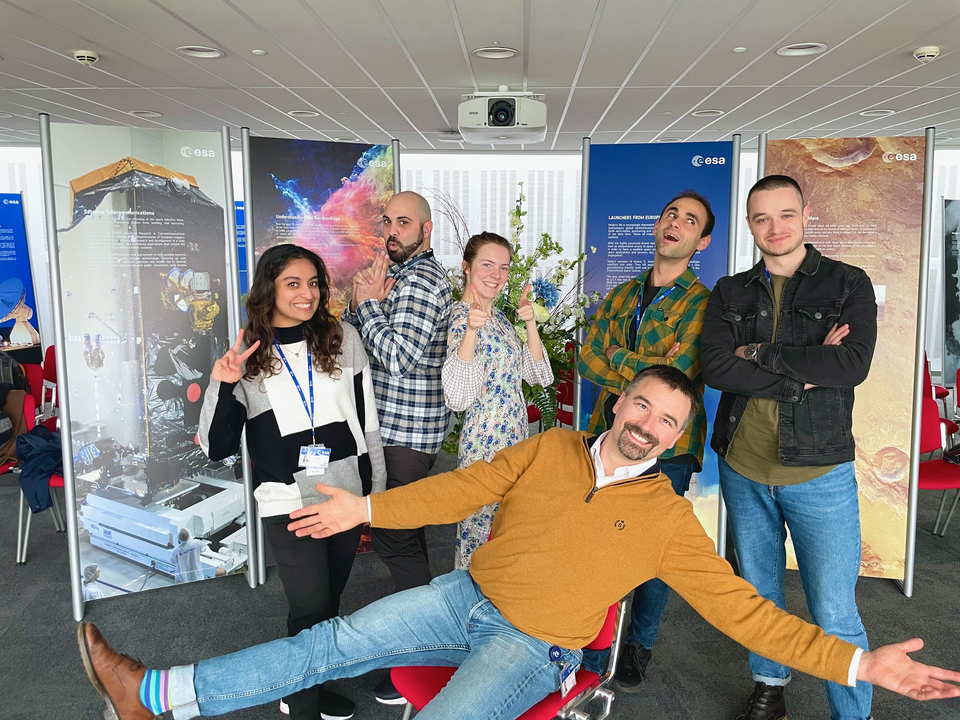
In July 2023, ESA opened a new state-of-the-art events venue at ECSAT and since then it has hosted around 60 conferences, covering topics such as artificial intelligence, climate change, and exploration. The conference centre is named after Magali Vaissiere, the first director of ESA ECSAT. In 2024, it hosted the very first ESA Open Day at ECSAT, which gave thousands of people the unique opportunity to explore behind the scenes at the establishment.
What’s next for ECSAT?
ESA is implementing a development pan for ECSAT that will build on the establishment’s achievements to expand its capabilities and grow its workforce over the next 10 years and beyond. With seven ESA directorates represented at the site, ECSAT is evolving into a multi-directorate and multi-disciplinary centre, supporting ESA’s evolution. Discussions with the UK authorities are under way that will guide the development and implementation of this plan.
